What matters most? And the three questions every founder must keep asking...
Every strategic decision your company will ever make is downstream of how well you answer them.

Founders spend enormous amounts of time discussing roadmaps, pricing, hiring, fundraising and go-to-market. Yet every one of those decisions ultimately depends on three more fundamental questions:
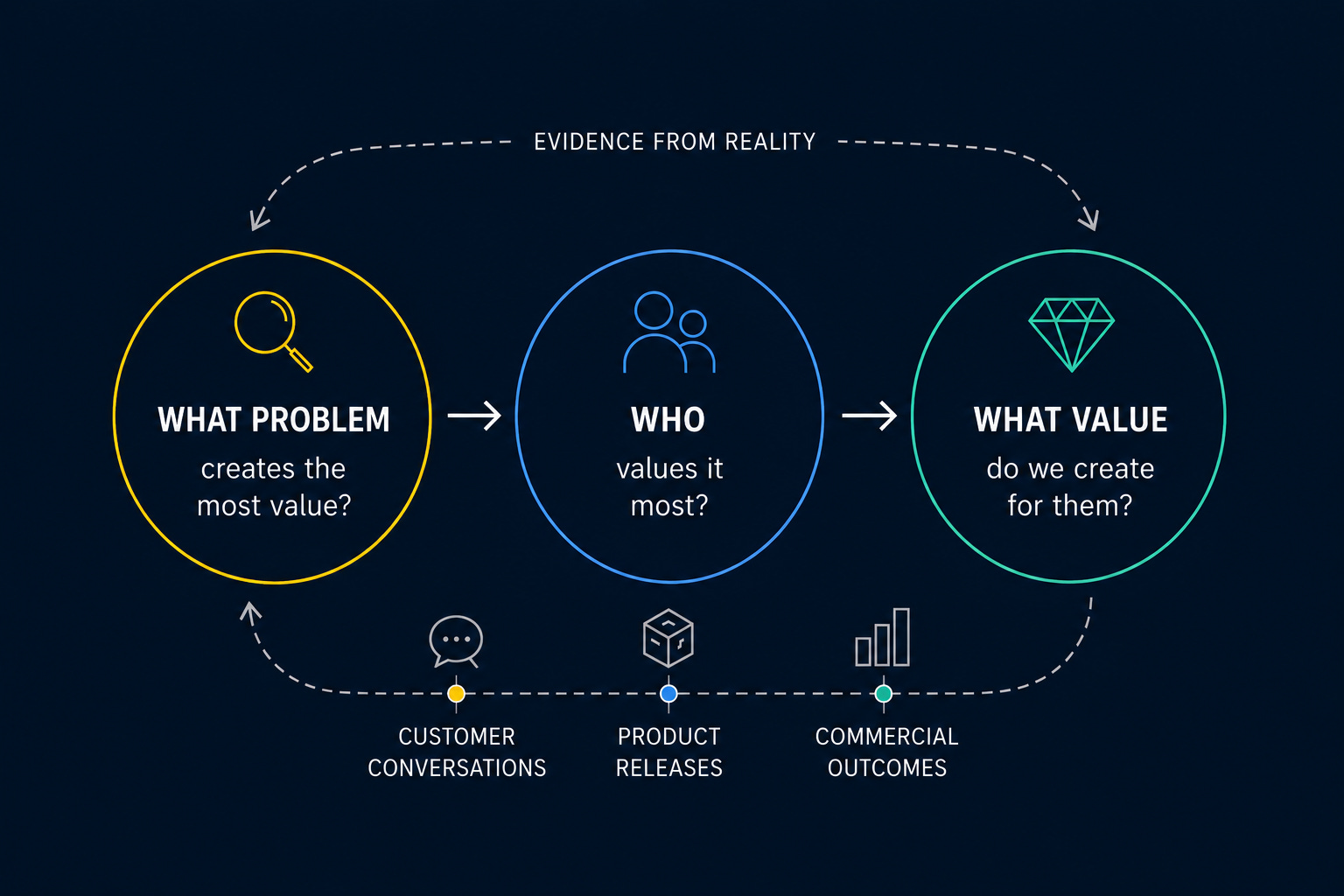
what problem do you solve?
who do you solve it for?
what value do you create?
The best founders don’t answer those questions once. They return to them relentlessly, allowing every experiment, customer conversation and product release to refine their understanding of what matters most.
They sound almost too simple to matter. Most founders have an answer to each of them before we’ve even finished our first meeting.
The interesting part isn’t the first answer. It’s what follows.
I’ve come to believe that almost every strategic decision a company makes is downstream of these three questions. Product strategy, go-to-market, pricing, hiring, partnerships, fundraising and even organisational design all depend, ultimately, on how well you answer these three fundamental questions.
If those answers are weak or based on outdated assumptions, everything built on top of them begins to drift.
Which is why we don’t move on to a different set of questions.
We come back to the same ones:
Is this THE most important problem you could solve?
Are these THE customers who value that solution the most?
Is this THE greatest value you could create for them?
Those aren’t refinements. They change the nature of the conversation.
The objective is no longer to define your business, it is to improve your understanding of it.
Every customer conversation becomes evidence.
Every product release becomes evidence.
Every commercial success or failure becomes evidence.
Each iteration should sharpen your understanding of the problem, the customer and the value you create.
Over time, those three questions become less like a checklist and more like a learning loop:
What problem creates the most value?
Who values that problem the most?
How do we maximise the value we create?
The framework scales because it is recursive.
Sometimes you refine the answers. Sometimes you discover there are multiple answers. In either case, every coherent business inside the company must answer the same three questions: what problem creates the most value, who values it most, and how do we maximise that value?
That is exactly what you should expect.
The best founders don’t cling to their first answers. They improve them.
AI doesn’t change this discipline. It accelerates it.
Founders can now build prototypes in hours rather than weeks, test ideas more quickly, speak to more customers, analyse more feedback and iterate at a pace that would have seemed impossible only a few years ago. The learning loop becomes dramatically faster.
That changes the economics of company building.
The cost of building the wrong thing falls because building itself becomes cheaper. The opportunity cost of pursuing the wrong problem, serving the wrong customers or creating too little value rises because you can now move so much faster in the wrong direction.
Sometimes those questions converge on a single, sharper answer. Sometimes they branch into entirely new opportunities, revealing that what appeared to be one business is, in fact, several value-creation systems waiting to emerge.
This is why I increasingly find myself returning to a different question.
What matters?
Not as an abstract philosophical question, but as a practical one.
What problem matters most?
Which customers matter most?
What creates the most value for them?
Everything else follows from there.
Your product roadmap is simply an expression of the problems you have decided matter. Your go-to-market strategy is an expression of the customers you believe matter most. Your pricing reflects the value you think you create. Your hiring plan reflects the capabilities you believe matter most. Your partnerships, your investments and your organisational priorities all emerge from the same underlying understanding.
If that understanding improves, every one of those decisions improves with it.
Immediately forwarded to my CEO/Founder. This is a a gem of an article.
Totally on the money, I start every founder conversation with the three questions:
What problem creates the most value?
Who values that problem the most?
How do we maximise the value we create?
This is the learning loop, when businesses fail they lose focus on these three core thing and start complicating offerings and packages. Every month, every product release, every campaign does it showcase your solution.