Your product can know everything except whether your customer is winning.
Products are measuring the work. Judging whether that work matters is something else altogether.

Software is becoming extraordinarily good at understanding its own performance. The question we need to ask ourselves is what that leaves for the people.
I put that question to Dan Steinman, who spent two decades defining the Customer Success discipline, first at Marketo and then as Chief Customer Officer at Gainsight. Nobody I know has thought harder about what it means to help a customer realise value.
We’ve been working together for nearly ten years. We didn’t always agree on this one.
Customer number thirty-one
I started by asking Dan when founders know it’s time to hand customer relationships to someone else.
His answer had nothing to do with ARR, headcount or the number of customers. Instead, he described two meetings. In the first, an investor asks, “What’s happening with customer number three?” Everyone in the room knows. In the second, the same person asks, “What’s happening with customer number thirty-one?” The room falls silent. “That’s when you need Customer Success,” Dan said.
The point isn’t that founders stop speaking to customers. Quite the opposite. In the early days, founders are the Customer Success Function. Every customer conversation teaches them something about their product, their market and their business. The problem is that this shared understanding gradually disappears as the company grows.
Dan sees Customer Success as the function that preserves it. Not simply by managing customer relationships, but by ensuring the organisation continues to understand where customers are succeeding, where they’re struggling, where value is being created and how the product must improve.
That, he argued, is why Customer Success belongs at the executive table.
If leadership teams review sales every week but rarely discuss customers, they’re ignoring one of the richest sources of strategic learning available to them.
The doctor and the diagnosis
Once we’d established that Customer Success exists to improve the product and organisational learning, the obvious next question was whether AI changes that role.
My instinct is that it must. As software becomes increasingly autonomous, products are taking on work that was once performed by people. Surely that changes what Customer Success looks like?
Dan wasn’t convinced. He suggested asking the same question about sales: “Does the need to sell an AI-native product fundamentally change what makes someone a great salesperson?”
Probably not. While the tools evolve, the work doesn’t. The technology has changed every decade. The objective hasn’t: build stuff, sell stuff, make sure the customers receive the value they expect.
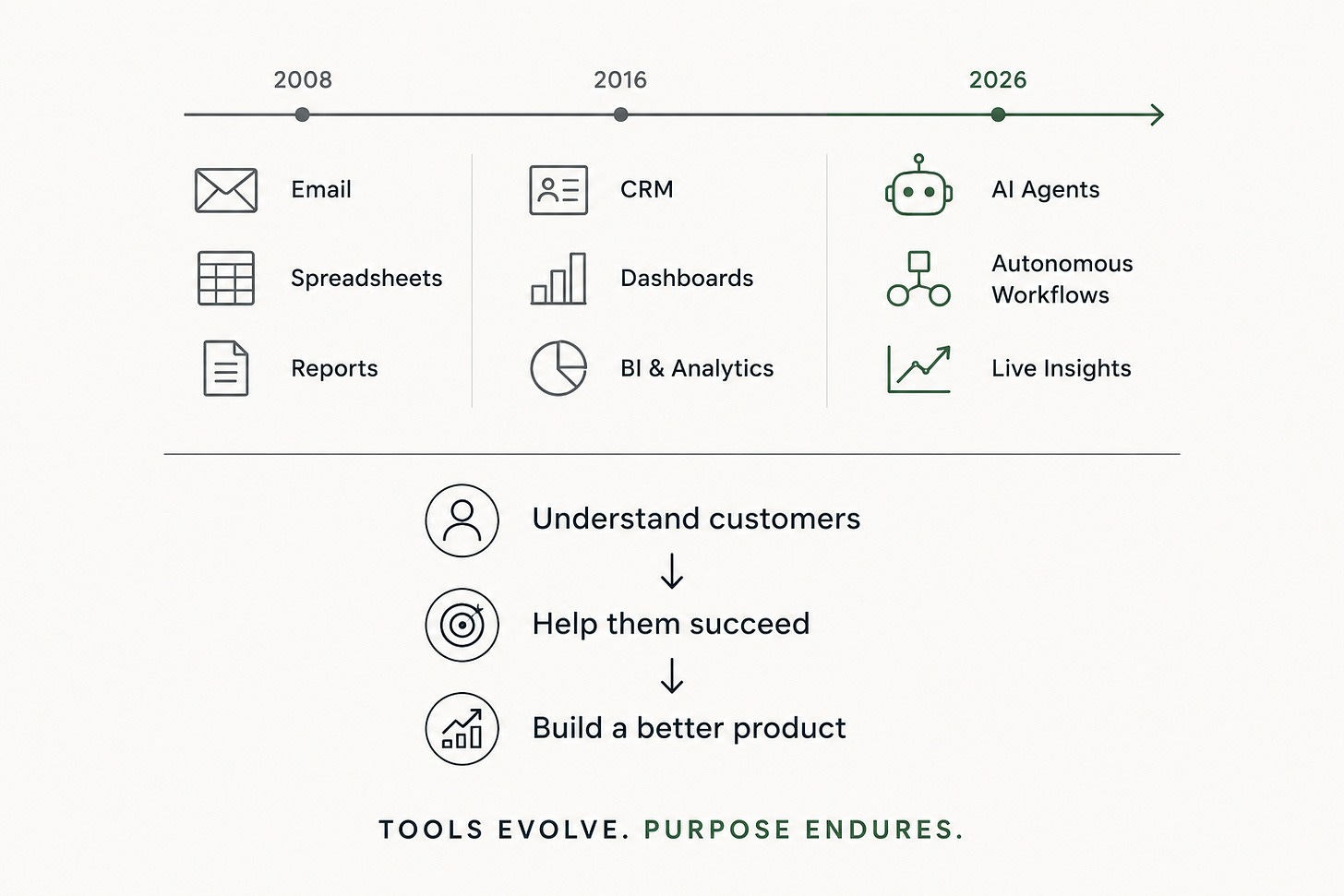
Customer Success, he argued, is no different. Its purpose remains understanding customers, helping them achieve the outcomes they bought the product to deliver, and ensuring the company learns and improves based on those interactions.
He compared it to medicine. Doctors have always adopted new technologies. Diagnostics have become more sophisticated. AI will undoubtedly improve the speed and accuracy of many decisions. None of that changes the doctor’s fundamental responsibility: understanding a patient’s health and helping improve it. Customer Success follows the same pattern.
I’m not convinced.
AI doesn’t simply give products better tools. Increasingly, the product itself is becoming capable of observing its own performance, learning from that performance and adapting accordingly. The question, I thought, wasn’t whether Customer Success changes, but which responsibilities migrate into the product, and which remain irreducibly human.
I agreed with the principle, but I wondered whether we were describing two different responsibilities.
One is outward looking: helping customers realise the value they expected when they invested in your product.
The other is inward looking: ensuring everything the company learns from those customers feeds back into building a better product.
Both felt equally important to me. Dan didn’t disagree. In fact, he argued that they’d always been inseparable. Customer health has always sat at the centre of Customer Success. The role has never been simply to maintain relationships. It has been to understand whether customers are genuinely becoming more successful, why they are, or aren’t, and what the company should do about it.
That raised another question: If Customer Success is ultimately responsible for helping customers realise value, how should companies think about measuring value when the customer may no longer be the person doing the work?
Observing value
Historically, software has relied on proxies. Logins, clicks, feature adoption; all of them stand-ins for value because value itself was never visible. The assumption was that activity correlated with worth.
But what happens when there are no users? If AI agents are performing the work, activity doesn’t disappear, it moves beyond human observation. A product may soon know far more about the work it performs than any human ever could. A warehouse robot knows every movement it makes. An AI agent knows every decision it takes. They don’t need to estimate activity through logins or clicks; they observe the work directly.
Which sounds like the end of the problem, but it isn’t.
Why? Because observing work is not the same as observing success.
A product may know it has completed a task faster, more accurately and at lower cost. It cannot know whether the organisation has used that improvement well.
I asked Dan how Customer Success should think about value in that world. He argued it had always been difficult.
“We’ve never actually measured value. We’ve measured things that we hope correlate with value.”
ROI models may help during a sales process, but they rarely survive first contact with reality. Every customer defines success slightly differently.
His approach was refreshingly simple, ask the customer this one question: “How will you know this investment has been worthwhile?”
Once you have that answer, identify the behaviours and capabilities most likely to predict it. At Gainsight that became the basis of customer health: a small number of capabilities that consistently appeared in successful customers, used as leading indicators rather than waiting for renewals to reveal whether things had gone well.
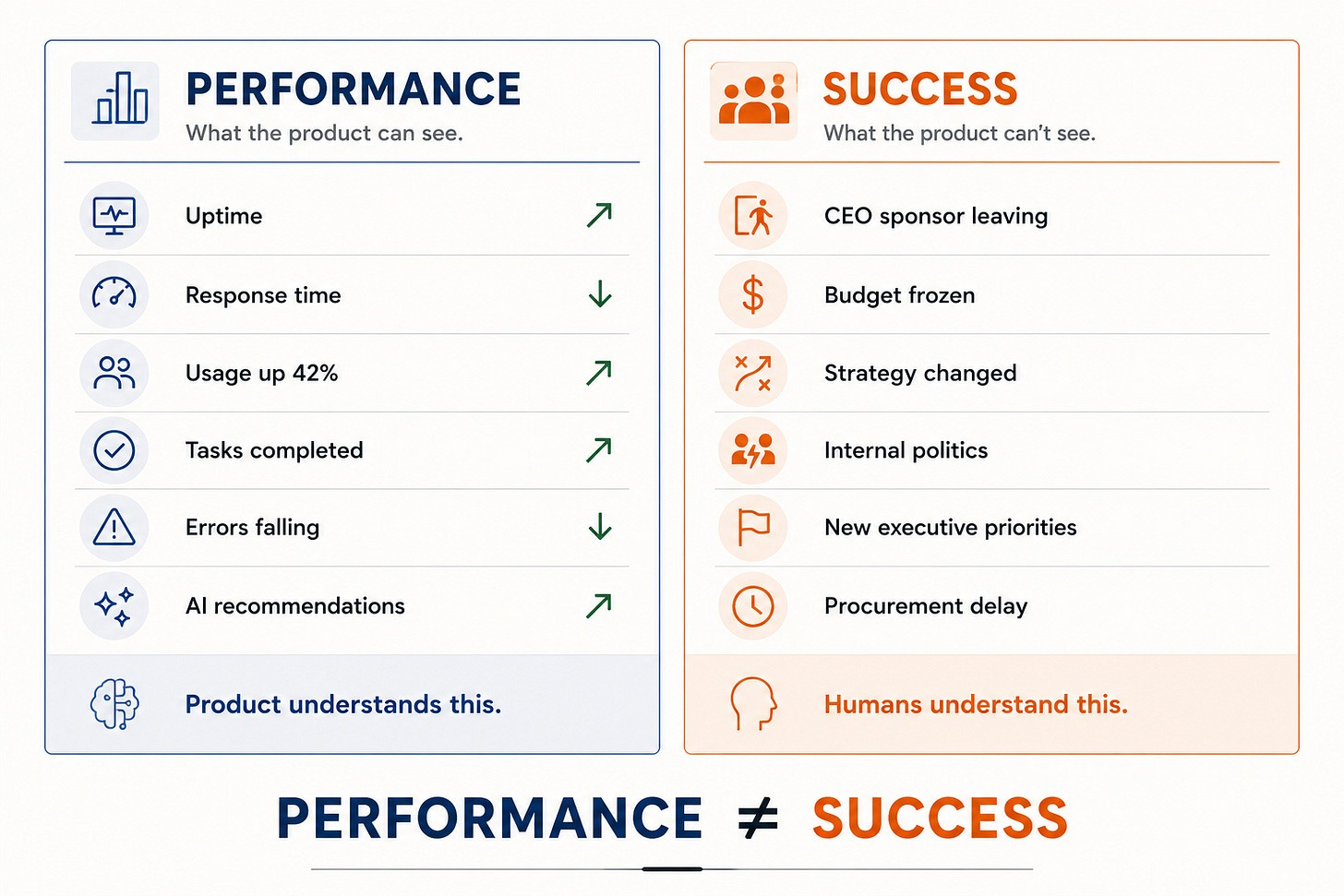
But Dan was equally clear about the limits. A customer may be using every feature you expect and still not be successful. They may find the product frustrating, their organisation may have changed, the executive sponsor may have left. None of that shows up in the metrics.
“The signals tell you where to look. The customer tells you what they mean.”
Which took us back to where we started. Perhaps the real purpose of Customer Success isn’t measuring value at all. It’s about preserving the organisation’s ability to see it.
Success is a shared responsibility
Thinking about value inevitably led us to another question. Who is actually responsible for creating it?
One of the recurring themes I see across our portfolio is that customers must be active participants in their own success. They don’t simply buy the solution and start using it.
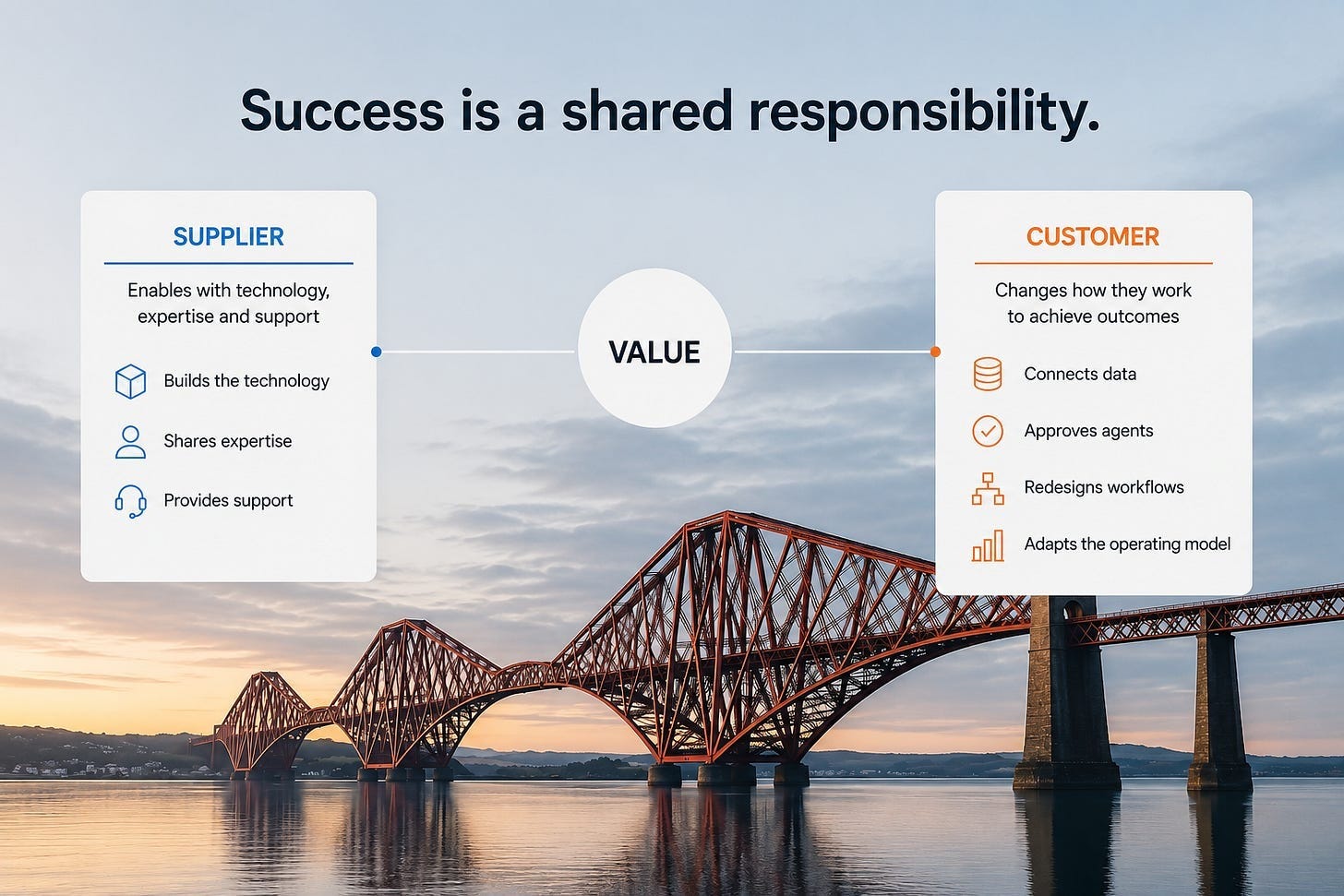
They connect data, approve agents, redesign workflows and, in the end, change how they operate. The supplier provides the technology. The customer has to change the company around it.
Value is created where supplier capability and customer commitment meet.
I asked Dan how Customer Success should respond. His answer came via a conversation he’d recently had with a founder who described a person he felt he was missing: someone who wakes up every day thinking about whether customers are genuinely getting value. Someone who makes sure the right people are involved, the necessary decisions are being made and both sides are doing what they had committed to do.
Dan’s response was immediate: “You’ve just described a great Customer Success Manager.”
Then he made a point I’d never heard expressed quite so clearly: “One of the most valuable things a Customer Success Manager can do is tell a customer they are unlikely to achieve the outcome they want.”
Not because the product has failed, but because they have. IT hasn’t provided access to the right data. The executive sponsor has disengaged. The implementation team hasn’t prioritised it.
Those are uncomfortable conversations. But avoiding them doesn’t improve customer success, it merely delays failure.
This reminded me of a company I’d been speaking to recently. They only had the capacity to onboard three new customers during the coming year. Three! Which changes the qualification question entirely, because the scarce thing is no longer the prospect’s budget but the supplier’s ability to deliver, and every slot they fill is a slot they cannot offer to someone better suited. So rather than working out how to persuade a prospect to buy, we talked about a different question: why should we choose you?
It sounds backwards until you follow it through.
If, as stated above, value is indeed created where supplier capability and customer commitment meet, then the customer’s willingness to do their share is not something you want to discover during onboarding, it is a qualification criterion. A prospect with budget and no executive sponsor is worse than no prospect at all, because they consume a year of delivery capacity and produce a reference you cannot use. Choosing the wrong customer is every bit as risky as choosing the wrong supplier.
Dan agreed. Great sales organisations don’t simply qualify whether a prospect can buy; they qualify whether they’re likely to succeed.
Does Customer Success become part of the product?
If products are increasingly responsible for creating value, shouldn’t they also become responsible for observing it?
I’ve been exploring this idea for some time under the label native observability: the idea that when a platform does the work, the outcome of that work becomes visible in the platform’s own data, without anyone having to be asked. Mews can see what a hotel earns per available room because every booking, rate change and check-in passes through it. The evidence doesn’t depend on the relationship.
I think products will become the primary locus of operational observation. They will recognise patterns, detect failure, surface opportunities and adapt without waiting for a human to intervene. In most domains they’ll understand far more about their own performance than any operator could.
What I’m less certain about is whether that extends to organisational success.
Dan’s instinct was that he’d seen this movie before. This was the problem Gainsight originally set out to solve: not simply collecting product data, but combining every signal that mattered (usage, support, commercial history, marketing engagement, renewals) into a complete picture of customer health. Could more of that capability move into the product itself? Absolutely.
But he was clear about the edge. Some of the signals that decide whether a customer succeeds have never been in the software at all. Organisational change. executive sponsorship, internal politics, competing priorities. A product can see behaviour. It cannot see the organisation around it.
This is a distinction I’ve been circling. Native observability gets you everything inside the system’s boundary, far more than we’ve ever had. In Mews’ case, their platform can now show that the hotel’s revenue per room went up. What it can’t tell is whether revenue per room was what the group was trying to move this year. It can’t tell if the executive who signed the contract still works there.
Product performance and organisational success are not synonymous.
AI-native products will become extraordinarily good at understanding performance.
Success remains a human judgement.
Organisations aren’t collections of workflows. Leadership changes, strategies evolve, teams restructure, budgets move. Companies sometimes become more efficient without becoming more successful. Those aren’t missing data points, they’re a different kind of information. A product can increasingly understand the system it operates within. It still can’t understand the organisation that created the system in the first place.
That doesn’t eliminate Customer Success, but I suspect it changes where the leverage sits.
A conversation with the founder of a robotics company came back to me. He described the progression from one operator controlling one robot, to ten, then a hundred, and eventually perhaps a thousand. The operator never disappears. Technology extends the reach of their judgement. The robots understand how they’re performing; the operator understands whether the operation is working.
Dan thought Customer Success follows the same path. When Gainsight was being built, he said, the question was never whether technology would replace Customer Success Managers. It was whether it could let each one carry twice as many customers, with better information and better judgement. AI simply extends that trajectory.
Which is roughly where we ended up. We agreed on the destination, but not quite on the mechanism. Dan sees AI increasing human leverage. I’m drawn to the idea that products will take over understanding and improving the work itself, leaving people to judge whether the work is making the organisation more successful. Both may turn out to be true, but either way the centre of gravity is moving.
Where to look, how to think
Products will get better at understanding and improving the work they perform. Neither of us doubts that. Whether they will ever understand if that improvement is translating into success for the customer is a different kind of intelligence: judgement about strategy, priorities, leadership and change, and about the organisation around the product rather than the product itself.
Which brings me back to something Dan said earlier, because I think it was the truest thing either of us managed. The signals are about to get much richer and cheaper. That doesn’t change what they’re for.
“The signals tell you where to look. The customer tells you what they mean.”
Stephen,
Conversations with Dan are always thoughtful - I have had many over the years.
I have a slightly different view of product and customer's success - note the apostrophe, which reinforces where the focus must be and sets the scope for the wider GTM implications.
Your Performance vs Success chart is correct but I think flawed because it describes the performance elements we have tracked, not what we should track. In 2016, I wrote "Product-led Customer Success, which argued that products should be built around a success process - helping a customer set, track and achieve a goal for a result that matters to them. AI is delivering the ability to do that at scale. What is lacking in most cases is leadership intent. I am in the process of rewriting the ebook ten years on. [You can read a summary in the blog "Are we building SaaS products the wrong way. https://clgforum.com/site/blog/post-1770398737248. TL:DR - yes!]
This results approach to product design is just one element of what I describe as customer-led growth: build a GTM wide approach that delivers profitable revenue by delivering measurable results to key roles in your chosen customers. GTM can only be aligned if there is a basis that all teams agree on. The results that matter to your chosen customers is that red thread.