Best practices are, at best, average.
Venture capital only cares about the exceptions. That’s the power law in action. Best practices are designed to reproduce the average outcome and in a world governed by power laws, the average outcome

I gave a talk to some MBA students on Friday, and kept coming back to the same point. Venture runs on a single law in which a tiny number of companies generate almost all the returns. In short, the power law.
When we think about everything we are taught about building companies, the frameworks, the benchmarks, the motions, are nearly all an attempt to capture what tends to work across enough companies to be named best practice. Which is a problem, because the thing that works across enough companies to be named a best practice is, by definition, an average, a path to the middle of the pack. And in the world of venture capital middle of the pack is failure.
A best practice is, by definition, average practice, and in a world of power laws the average is a mediocrity you should not accept.
This is why I keep coming back to principles rather than playbooks, and I have made the case against the playbook more than one way before: That a playbook is someone else’s answer, derived against a market that was theirs and not yours; that a playbook encodes the limits of a world that has since moved on.
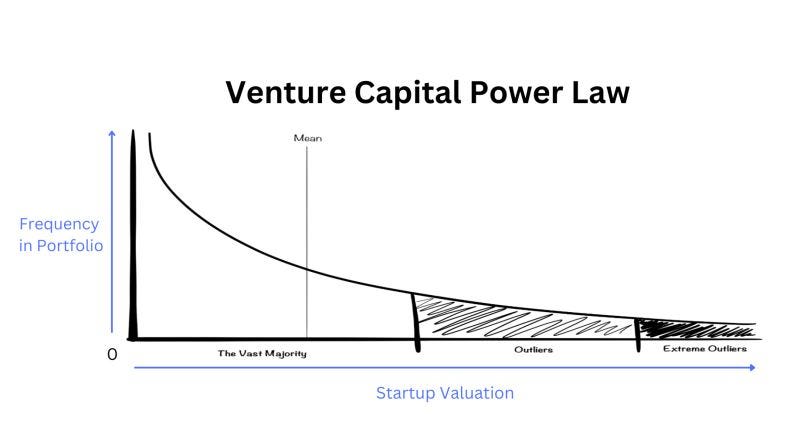
Both are true and both matter. But the power law gives the harder objection underneath both, which is that even a playbook that is yours may still only carry you to the average, and the average is not the game you are in.
Take go-to-market, where the playbooks are most lovingly maintained.
I recently wrote up what is actually working with AI in go-to-market, drawn from a Notion Capital workshop led by Harrison Rose, together with Al Simpson and Even Walser, and the example that has stayed with me is the most ordinary one imaginable: targeting customers by their job title. We have done it for decades, not because the title ever told us that someone would buy, but because it was something we could hold on to. Asking “who is actually responsible for the pain, who has the need and budget?” was not something a team could do at scale, so the title became the stand-in.
And here is the part worth considering. The job title was never best practice. Nobody ever proved it was the right way to target a market; it was simply inherited, passed from one company to the next until it felt like the natural order of things. That makes it received wisdom, the more dangerous relation of best practice. Because best practice at least had to work at least once to earn the name, whereas received wisdom only had to go unquestioned long enough that we forgot it had ever been a choice.
Best practice carries you to the average. Received wisdom cannot even manage that.
What was fascinating about the discussion is that the constraint which forced the workaround in the first place is dissolving.
Even Walser described the shift as moving from a system of record, to a system of context, to a system of action, and making the business readable in that way is the precondition for all of it. I have written about why most companies don’t yet have that readability. But readability used just to run the old motion faster is not the prize. Ask rather who is responsible for the outcome you seek and the proxy disappears, because you can now read responsibility directly, from reporting lines and tenure and what someone actually owns. The annual process of building target personas, the quarterly forecast, the experiment gated behind weeks of coordination: each was received wisdom built for a world of scarce information and even scarcer ability to execute.
In short, received wisdom is a simplistic answer to yesterday’s question.
What replaces it is the discipline of deriving your own buying personas against your own market and your own customers, and then proving the result honestly, by seeing whether customers are genuinely and measurably more successful because of you in their own data. That is harder and slower and far less comfortable than adopting the thing everyone agrees on, and it is the only work with any chance of making you the exception to the rule.
None of which means everything inherited is worthless.
Some of it encodes hard truth, paid for in other people’s failures, and discarding it on principle is its own kind of foolishness. Knowing which to keep and which to throw out is judgement, and judgement is the part that remains stubbornly human. But the default posture has to flip. Not “this is best practice, so adopt it,” but “this is best practice, which means it is average, so what would beat it?” And when the thing turns out to be received wisdom rather than best practice, the question is sharper still, because you are no longer weighing the average against the exception, you are asking whether it was ever true at all.
Be wary, above all, of anyone sure they already know.
The most useful sentence I have is still “I don’t know.” It is the honest starting point for the only question that matters, which is not how to reproduce what worked for the average company, but what the exception would do here, now, in a game whose rules are still being written.
Adopt the best practice, absorb the received wisdom, and you will, reliably, arrive at the average.
Stephen Millard is Partner and Chief Platform Officer at Notion Capital, Europe’s leading early-stage investor in B2B software and AI-native companies.
My thought about this is that when something works once for someone, they make a playbook about "how they did it." I'm not a fan of most playbooks, as they mostly make money for the creator while leaving most users in the dust.
When a bunch of people use a playbook, and some elements of it works for many of them, then over time some of these playbook elements can become "best practices." I do like to consider best practices when looking at addressing issues, but they can't be used blindly or alone. They are generally but a single element among many that go into the decision-making process.
But think about it, there are always so many variables and circumstances that come into play in any given situation. The best course of action is for the founder to use their intelligence to synthesize all the inputs into a cohesive whole of understanding, and then make an intelligent decision given all of that.
Most playbooks, best practices, and even AI at this point are not able to do that, and that's why they so often don't achieve the outcomes that were hoped for.